Search this site
30 results found with an empty search
- The Path to Fishing is Narrow and Winding
Haida Gwaii Safaris is located in Haida Gwaii in the little town of Sandspit. Sandspit is on the east coast of Moresby Island. And if you didn’t know, we do all of our fishing off the west coast of the islands in Cartwright Sound. So how do we get there? Well, we definitely don’t go around the island, that would take way too long. Lucky for us, there is a channel that goes between the northern and southern main islands (Graham Island and Moresby Island respectively). This is the Skidegate Channel. The Skidegate Channel This channel is narrow, winding, and fairly shallow. The depth of the channel is greatly influenced the daily tides. Because of the constantly changing depths it can be difficult to navigate through, if not impossible, for typical fishing boats with outboard motors. Even up to a few years ago, we had to go out to fish and come back to the lodge with the tide to make sure it was safe to travel through the Skidegate Channel. This meant leaving to fish at different times every day and sometimes leaving to fish before the sun came up! But we now have an amazing fleet of jet boats, so our fishing times are no longer as influenced by the tide. The travel from Sandspit to Cartwright Sound takes about an hour and it’s an incredible journey! The Skidegate Channel is a very scenic route, to say the least. The forests of Haida Gwaii go right up to the coasts, so the views from the boats are full of lush trees and little beaches. And not to mention all of the wildlife! Bald eagles often nest among the trees through the channel, and many can be seen flying and eating through this area. Deer and sometimes Haida Gwaii Black Bears can be seen on the beaches as well! The Skidegate Channel may be a long, winding journey, but we think it’s a journey well worth it.
- Haida Gwaii’s Rare Bear Species
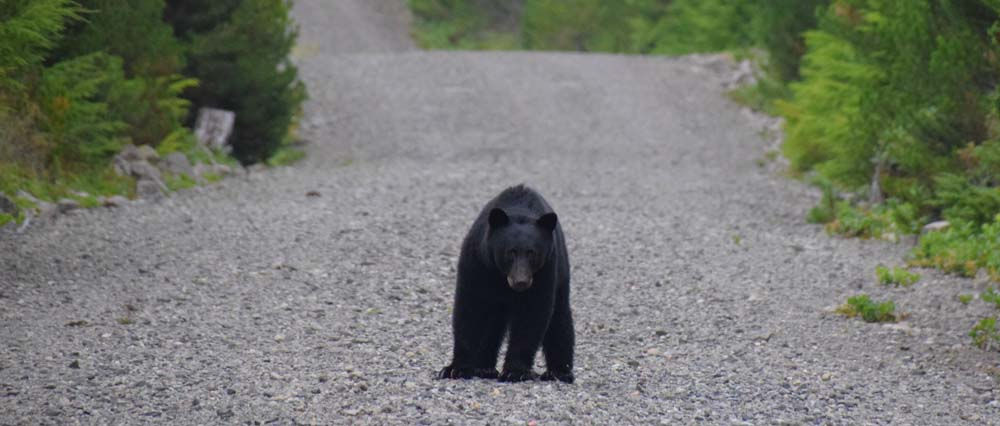
Haida Gwaii Black Bears Meet the Haida Gwaii black bear. These bears are endemic to Haida Gwaii. Meaning that they are not found anywhere else in the world! The Haida Gwaii black bear is a subspecies of the American black bear. They are considered the largest of the subspecies. Over time they have evolved to have a larger head, jaw, and molars to crack open crabs and barnacles more easily [1]. Unlike mainland subspecies of the American black bear, the Haida Gwaii black bears are exclusively black with tan muzzles. They are omnivorous. Meaning they eat a mixture of shellfish, salmon, and greenery (including berries in the summer). They hibernate for three to five months during the winter and make their dens in hollow cedar trees or stumps. Females typically give birth in while they’re hibernating in January to two or three cubs before coming out of hibernation in April or May. Haida Gwaii black bear cubs stay with their mothers for about a year and a half before moving on to make a life of their own [2]. Ecosystem Haida Gwaii black bears serve as a keystone species to the islands. Their presence has changed their environment. Their ecosystem would not function the same way without them. A large part of the bears’ diets include salmon. They tend to bring at least part of the salmon carcasses inland to the forests. As I stated in a past blog post about the difference between Chinook and Coho salmon, salmon carcasses release nitrogen and phosphorous into the environment as they decomposition. By bringing dead salmon into the forests, the bears are fertilizing the soil and promoting healthy plant growth [3]. The bears prefer to avoid areas on the islands that have high populations of people but will enter these areas when hunting or foraging. If you come across a bear on the islands, it is recommended by Gwaii Haanas National Park Reserve to calmly leave the area. Bears typically will only attack people if they are startled or believe that their food source or cubs are being threatened [4]. They tend to prefer to mind their own business as they just want to live their lives and eat food like the rest of us! [1] “Meet Haida Gwaii’s Black Bear.” Haida Tourism, accessed January 27, 2022, https://www.haidatourism.ca/news/blog-post-title-four-kp8hj. [2] “Haida Gwaii Black Bear,” Bear Conservation. accessed January 27, 2022, http://www.bearconservation.org.uk/haida-gwaii-black-bear/. [3] “Meet Haida Gwaii’s Black Bear.” [4] Government of Canada Parks Canada Agency. “Bear Aware – Gwaii Haanas National Park Reserve, National Marine Conservation Area Reserve, and Haida Heritage Site.” May 8, 2019, https://www.pc.gc.ca/en/pn-np/bc/gwaiihaanas/securite-safety/ours-bears-1.
- The Beauty of the Sleeping Beauty Trail
Here at Haida Gwaii Safaris, we aren’t just known for our great fishing. But we’re also known for our touring! One of the fun and beautiful touring opportunities is to hike the Trail. This is another name for the Tarundl Trail and is a two-part trail. The first part that is more commonly known and hiked takes you to the top of Mt. Raymond near Queen Charlotte City. The second part of this trail takes you along the ridge walk from Mt. Raymond to Mt. Slatechuk [1]. The trail from the trailhead to the summit of Mt. Raymond and back is about 3 miles (5 km) and has a 2,100 ft (640 meters) elevation gain [2]. Sleeping Beauty Trail Mt. Raymond and the surrounding mountains create the shape of a woman lying down, which coined the common name of the trail, Sleeping Beauty. The Sleeping Beauty Trail forms the nose and Mt. Raymond is the tip of her nose [3]. This trail is part of a rainforest climate zone and is filled with luscious green trees and unique greenery. But the hike isn’t just a pretty face! Filled with bridges, wooden steps, and many large roots to climb over. It is impossible to get bored hiking this fun trail [4]. You will enjoy the entire hike from trail head to summit with stunning views throughout. Although we love to recommend this trail to anyone staying at Queen Charlotte Safaris, this trail is not for everyone. The trail is fairly steep for the majority of the hike. It can be difficult on your knees and ankles when coming back down due to loose rocks and dirt [5]. This is the trail for regular hikers looking for a little extra challenge and fun on their trip! [1] “An Awakening Hike Up Sleeping Beauty.” GoHaidaGwaii (blog). May 10, 2021, https://gohaidagwaii.ca/an-awakening-hike/. [2] “Sleeping Beauty – Tarundl Mountain.” AllTrails.com. accessed February 21, 2022, https://www.alltrails.com/trail/canada/british-columbia/sleeping-beauty-trails-tarundl-mountain. [3] “An Awakening Hike Up Sleeping Beauty.” [4] “Sleeping Beauty Hiking Trail.” eh Canada Travel, accessed February 21, 2022, https://www.ehcanadatravel.com/british-columbia/haidagwaii/parks-trails/4722-sleeping-beauty-hiking-trail.html. [6] “Mount Tarundl Overlooking Haida Gwaii .” Mon Amie (blog). accessed March 17, 2022, https://www.monamie.ca/adventures/mount-tarundl-haida-gwaii.
- 7 Reasons Why June is a Great Month to be in Haida Gwaii
1. Longer days June has the longest days of Summer with more daylight than the later months. More time with the sun up means more time fishing, touring, and having fun! 2. Less rain Not only are June days the longest, but they are also the driest in Haida Gwaii! We never let the rain stop us from our fun activities, but that doesn’t mean we don’t prefer to spend our time warm and dry! 3. Better fishing The early bird catches the worm! Or fish! Salmon begin their yearly migration from the Bering Sea in March and arrive in Haida Gwaii by the end of April. June is the beginning of thefishing season in Haida Gwaii, so there has been little to no fishing pressure on the fish during this time. And who doesn’t want to be among the first to fish of the season when it’s even more likely to get an amazing catch? 4. Less crowds Did you know the busiest month of summer travel is July? Beat the travel crowds and go on your summer trip early! There will be less people in airports, on planes, and in Haida Gwaii! 5. Greater chance of seeing whales Humpback whales migrate from Mexico and California up to Alaska in the late spring. June is the tail end of their travels and many of them pass through Haida Gwaii during this time (“Humpback Whale”). Humpback whales also tend to stick to the coasts at the beginning of summers for feeding, and because it’s the beginning of the fishing season, there’s more fish for them to eat! Although there is a small population of grey whales that live year-round in British Columbia, most grey whales migrate from Mexico to Alaska in late spring and can be seen passing through the west coast of Canada in June (“Grey Whale”). Grey whales feed on small invertebrates in eelgrass beds that grow abundantly around Haida Gwaii which makes the islands a great place for a lunch break in June (“Eelgrass Beds”). 6. Best chance of seeing all other types of wildlife In addition to whales, there are many other types of wildlife that are commonly seen in June. In June, you might see a northern fur seal during its migration to Alaska for the summer breading season (“Northern Fur Seal”). Sitka black-tailed deer are typically born in late May to early June, so it is the most likely to see a baby deer with its mother in June (“Sitka Black-Tailed Deer Biology”). And the Haida Gwaii black bears come out of hibernation with their cubs in May and are most commonly seen in June (“Haida Gwaii Black Bear”). Did you know that Haida Gwaii black bears are endemic to Haida Gwaii and can’t be seen anywhere else in the world? 7. Father’s Day Is there a better way to celebrate Father’s Day than by fishing? We don’t think so. Here at Queen Charlotte Safaris we know how to celebrate. For this June holiday we have fun games, specialty cocktails, and a delicious surf and turf dinner! Sources “Eelgrass Beds.” Oceana Canada, https://oceana.ca/en/marine-life/eelgrass-beds/. Accessed 25 Feb. 2022. “Grey Whale.” B.C. Cetacean Sightings Network, https://wildwhales.org/speciesid/whales/grey-whale/. Accessed 25 Feb. 2022. “Haida Gwaii Black Bear.” Bear Conservation, http://www.bearconservation.org.uk/haida-gwaii-black-bear/. Accessed 27 Jan. 2022. “Humpback Whale.” B.C. Cetacean Sightings Network, https://wildwhales.org/speciesid/whales/humpback-whale/. Accessed 25 Feb. 2022. “Northern Fur Seal.” NOAA Fisheries, 8 Feb. 2022, https://www.fisheries.noaa.gov/species/northern-fur-seal. Alaska, West Coast. “Sitka Black-Tailed Deer Biology.” The Sitka Black-Tailed Deer Coalition, https://sitkablacktail.org/deer-biology. Accessed 25 Feb. 2022.
- What Makes A Unique Salmon Fishing Resort?
Just like the prizes they seek, the most dedicated anglers migrate all over the world in search of the best salmon fishing. Increasingly, that has meant going to the ends of the Earth – the last unspoiled places – looking for a unique salmon fishing resort that lives up to the name. For many anglers, that ideal land is somewhere pristine and quiet, where crowds of people never outnumber schools of fish no matter the time of year. British Columbia, Canada, may not seem like the most exotic place on the top salmon fishing list. Take a second look, though, and you’ll see ours is truly the last frontier for salmon fishing. And at Queen Charlotte Safaris, we think we have a pretty good claim as a truly unique salmon fishing resort. Let’s take a closer look. The World’s Best Chinook Salmon Fishing A unique salmon fishing resort should have unique salmon – and Queen Charlotte Safaris stands out. The Chinook is the largest species of Pacific salmon. An adult Chinook salmon averages two feet long and 30 pounds, but record catches can grow up to 4.9 feet and 129 pounds. Chinook salmon meat is red and softer than other wild salmon meat, making it a pleasant and inviting seafood main that goes with many dishes. British Columbia’s breathtaking Haida Gwaii Archipelago is a magnet for these salmon, drawing them from the Bering Sea each March to arrive in April. Once there, fishing season stretches seven whole months – more than three times as long as the fabled Alaskan salmon season. Almost every major salmon run from the Skeena, Frasier, and Columbia River systems on Vancouver Island’s west coast must pass through Haida Gwaii on their annual journey. Cartwright Sound spends the whole season packed with salmon, giving intrepid anglers plenty to do day and night! No other salmon fishing resort can promise virtually no downtime between salmon runs – because there is simply no place on Earth quite like Haida Gwaii. From beginners to experts, anyone can enjoy a salmon fishing resort where hardly a week goes by without a record catch for the year. And what other salmon fishing resort also offers ample opportunity to catch halibut, ling cod, yellow eye, and bottom fish? Our calm coastline waters are dotted with reefs used as habitats by a diverse array of desirable fish. From May through September, visitors can catch delicious halibut – the Pacific’s largest flatfish – with no quota. Fresh-Cooked, Chef-Prepared Meals in a Fishing Lodge You’ll Never Forget Our lodge is your home away from home, including private washroom and shower with each guest room. Each morning you’ll wake to the view of golden sun on picturesque Shingle Bay. After a long day out on the water, a unique salmon fishing resort should offer a comfortable place to rest and tell all those fish stories! But that’s not all: Every evening is capped with an unforgettable chef-cooked meal. From lobsters, clams, oysters, crabs, steak – and, of course, every variety of Haida Gwaii fish – each meal is prepared from the freshest and finest ingredients right in our kitchen. Years of experience mean every delicious dish is handcrafted to tantalize your palate. No matter what the day’s catch, you’ll never go to bed hungry! And there’s one more thing we should mention about a unique salmon fishing resort: An all-inclusive, no strings attached experience so you can focus on fun. That’s our promise, and that’s just one more reason you’ll want to come back again and again. Discover Haida Gwaii with us. Contact Queen Charlotte Safaris today.
- Not All Salmon Migrations Are Equal
Salmon Migrations What we know about the habits and deep sea migration of pacific salmon is flawed to say the least. Salmon are relatively easy to study at the beginning and end of their amazing life cycle. It is the 1000 or so days in between that we have the hardest time deciphering. Lucky for us the shifting light for global awareness of this remarkable species. New and continued research by marine biologist on both sides of the 49th parallel are leading us towards some answers. Chinook Salmon Last November I attended the Sport Fishing Institutes Annual Policy Conference in Vancovuer, B.C. During the sessions of the day I was fortunate enough to hear a talk by Scott Hinch, about just this topic! As an avid fisherman and self appointed life long learner, scientific studies like these are exactly what I love to hear about. I understand this is not everyone’s cup of tea however; the more we know about salmon behavior, the better we can predict mid and early season migration. All though the Hinch presentation deals with Salmon in the Salish sea, (the origin for some of the salmon we catch off the coast of Haida Gwaii) we have a lot to learn from any study of juvenile salmon. Hinch’s study dealt with V4 tagging fish and then releasing them from a fixed location to monitor the migration and selection through the Discovery Islands. Key Findings Some key findings that I take away from reading this study is just how far these fish migrate everyday while on there way to and from the fishing grounds. Tagged salmon moved between 15 to 50 miles per day. That is a long way for a fish that is less than 4 inches, on its way to becoming an adult. As the salmon age and start to return to the spawning grounds we see similar distances on average. Though some species migrate as far as 80 miles per day when making a short run and an average of 25 miles per day when talking about salmon that swim deep into the interior of BC. What we still don’t have an accurate view of is the depth at which salmon seem to migrate and what conditions cause them to change depth in the water column. The salmon we catch are usually between 45 and 120 feet deep however; Chinook salmon have been observed migrating at depths well beyond 500 feet. The current science leads us to more questions than answers when it comes to how or why so deep but, I do know that I would be excited to haul up a spring salmon from the depths of 300 ft plus. That is the beauty of our vast fishing grounds in Haida Gwaii. B.C. While the majority of the salmon caught are predominantly in the water near the wall in Cartwright sound. We are learning that the old way is not the only way when it comes to the targeting and catching of west coast pacific salmon. By George Wall-Queen Charlotte Safaris Operations Manager & Shipwright


